

Your 5 weekly reads:
Nvidia down 6.1% despite blowout earnings
Upcoming SpaceX IPO: What it means for your portfolio
SpaceX's $75B raise would dwarf every IPO before it
Equity planning around a liquidity event
OpenAI’s newest multi-millionaire employees
✉ Know someone who'd love this? Share this newsletter by sending out your unique referral link. Your friends subscribe, you earn rewards. Copy your link here.
1. MARKET ROUNDUP
Nvidia Drops Despite Strong Q1 Earnings

SpaceX filed its S-1 this week, disclosing they’re targeting a June IPO of up to $75B at a $1.75T valuation, which would make it the largest IPO in history.
Nvidia reported Q1 earnings on Wednesday, with revenue hitting a record $81.6B, up 85% YoY. The stock slid 6.1% this week despite earnings beating Wall Street's $79.2B estimate.
Consumer sentiment reached record lows in May. Inflation expectations rose to an annualized 3.9%, up from April’s 3.5%.
The Trump administration awarded $2B across nine quantum computing firms, taking a minority equity stake in each — all but one surged 20%+ Thursday.
Range Takeaway: Once again, Nvidia checked nearly every box on Wall Street’s wish list, only to watch its stock slide the next morning. This “blowout earnings, next-day drop” pattern has now played out for four consecutive quarters. The knee-jerk reaction hasn’t been a very effective predictor of longer-term moves; each time, the stock recovered to new highs by the next quarterly release.
2. THE BIG TAKE
SpaceX is Ready to Launch
By Taresh Batra, Chief Investment Officer

We've known for months that SpaceX was planning the biggest IPO in history, a move that will immediately vault it into the top ten most valuable companies globally. With this week's S-1, we finally got a detailed look at what we're getting for the historic $1.75 trillion price tag.
Investors will debate the path to profitability, technical risks, and governance. But at roughly 95x revenue, SpaceX's valuation isn't about today's core business. It's about the potential for moonshots like orbital data centers, leisure travel by rocket, and colonization on Mars.
It will be years before we know if these bets play out. Near-term, performance will likely be driven by retail demand and forced index buying from accelerated Nasdaq-100 and S&P 500 inclusion, which will quietly put SpaceX into millions of retirement accounts.
A successful IPO could pave the way for OpenAI and Anthropic, the second and third most valuable private companies in the country, waiting their turn to enter the public arena. Any meaningful hiccups may call into question public markets’ ability to absorb the next generation of mega-cap tech.
3. BY THE NUMBERS
SpaceX’s Otherworldly IPO
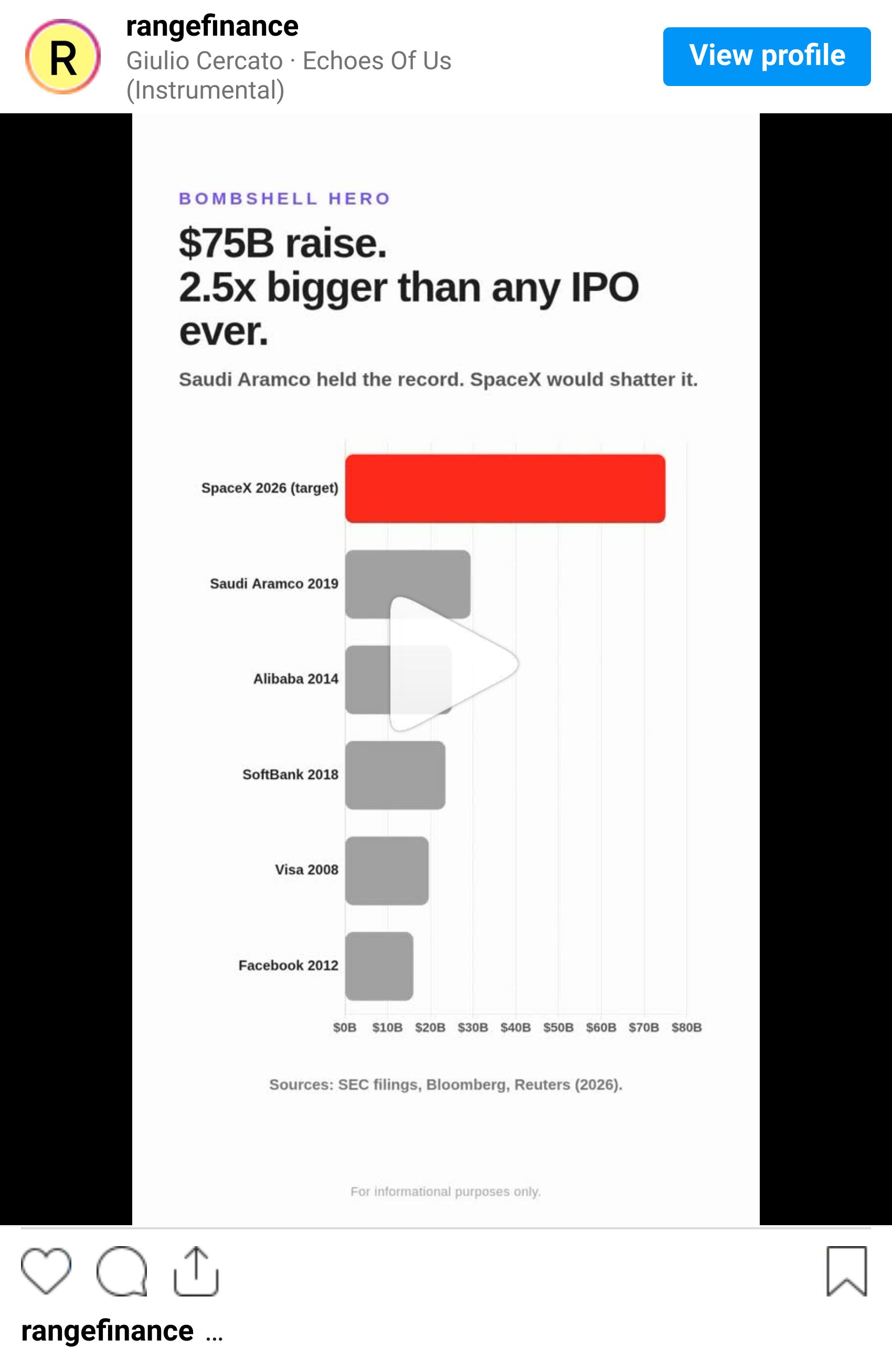
$75B: SpaceX's IPO target, which would make it the largest in history (2.5x larger than the previous record holder, Saudi Aramco).
$1.75T: SpaceX’s IPO valuation target.
$5.55B: Cerebras' May IPO — the largest US tech listing since Snowflake in 2020.
$160B: Goldman Sachs' forecast for total 2026 US IPO proceeds, roughly 4x 2025.
4. FROM THE RANGE TEAM
Planning Around Major IPOs

With SpaceX having filed its S-1 this week, the planning clock is ticking if you hold equity in the company.
There's one misconception worth clearing up first: equity doesn't automatically accelerate at IPO. What the filing does is start the countdown to when you’ll actually be able to sell your vested equity.
Here’s how the progressive equity lock-up release schedule is structured:
20% unlocks after Q2 2026 earnings, plus an additional 10% if the stock closes 30%+ above the IPO price for 5 of the prior 10 trading days
7% increments at days 70, 90, 105, 120, and 135 post-offering (35% total)
28% unlocks after Q3 2026 earnings
All remaining shares at 180 days post-offering
It's one of the more complex release structures we've seen — with multiple decision points tied to both a calendar and a price target. Having a plan mapped out in advance can make a real difference, especially if you hold VOO, VTI, or QQQ. These funds will likely add SPCX within days of the IPO, compounding an already concentrated position. Knowing your total exposure before the first window opens is a good place to start.
5. BEST OF THE DAILY RANGE
Get More from Range on Instagram
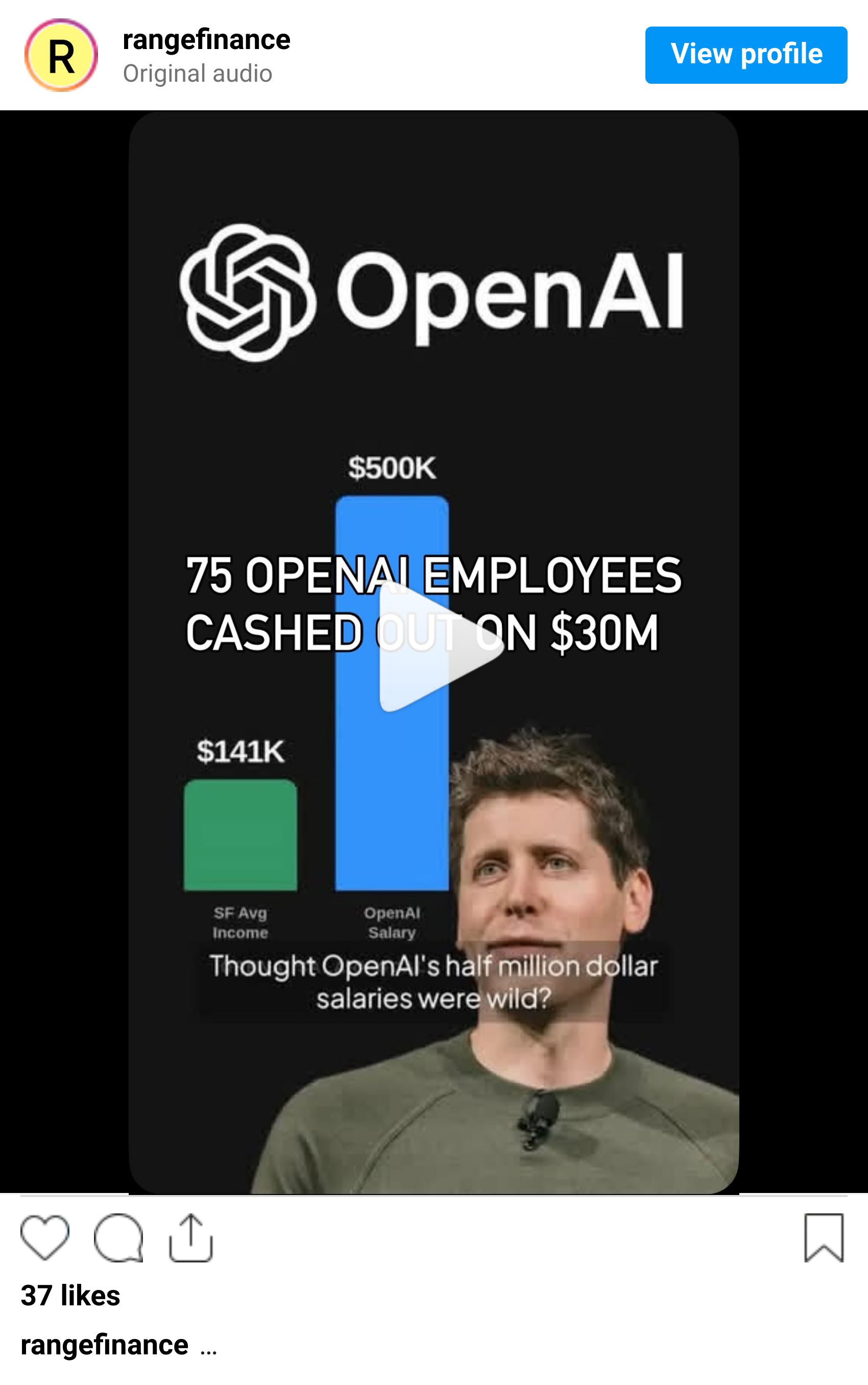
75 OpenAI employees just pocketed $30M each, in a tender offer that paid out $6.6B before the company even went public.
We broke it down on The Daily Range — our Instagram show that turns the week's biggest stories into 60-second hits. This week alone: Waymo’s recent recall, Mark Cuban partnering with President Trump, and data centers moving to outer space. A new one drops every weekday.
Follow @rangefinance on Instagram and turn on notifications so you don’t miss Monday’s.
RAI PROMPT OF THE WEEK

SpaceX employees aren't the only ones rethinking their equity strategy — anyone holding shares in a public company or a pre-IPO startup should have a plan.
This week, Range Member Success Manager Eloisa Cotanda asked: "If I give you my equity grant agreement, can you walk me through the total value of my equity today, and what I should do with it?"
Once you upload the PDF document, Rai reviews it alongside your tax situation and financial goals to break down your current equity value and deliver a clear action plan — what to exercise, hold, or sell, and when.*
Before we go…
💪 From Bloomberg: Forget Healthspan. Midlife Men Face Pressure to Extend ‘Hotspan’

HELP US GROW OUR COMMUNITY
Share Range. Earn Rewards.
We just launched our newsletter referral program. Share the Weekly Review with people in your life, and unlock exclusive Range gear at every milestone—stickers, mugs, hats, and more.
How it works:
1. Grab your unique link below
2. Share it with someone who'd benefit from sharper financial thinking
3. Hit a milestone — we ship your reward
Know someone who actually enjoys reading about money? They're your fastest first referral. ✅
*Please see Range Advisory’s ADV Part 2A for important risk disclosures and risks related to the use of AI. Recommendations depend on the accuracy and completeness of the information you provide to us. Recommendations based on incorrect or incomplete data may not be accurate.